
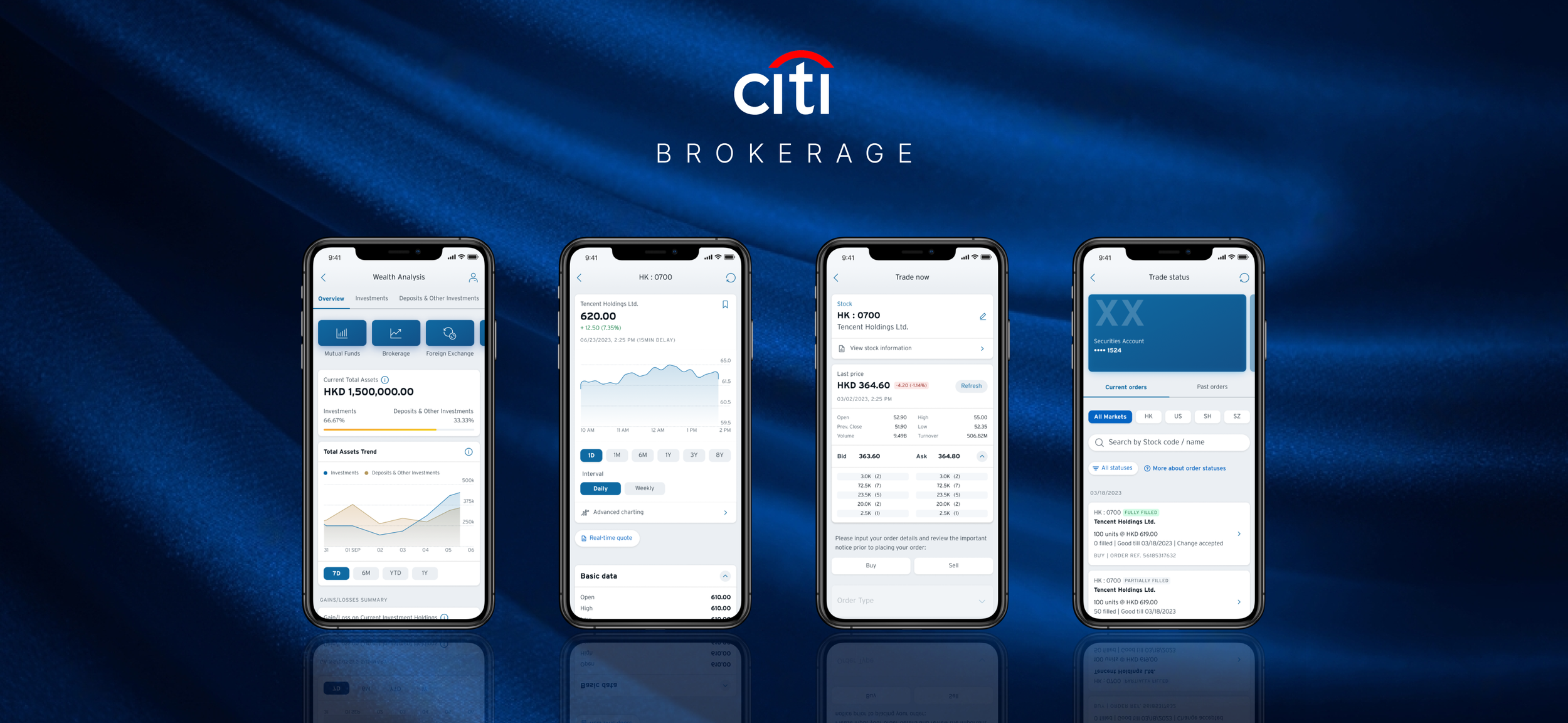

I spent a large portion of my first year at Citi working on revamping and enhancing the consumer Brokerage Platform
Process
When I joined Citi, the Wealth design team was in the midst of sun-setting Sketch in lieu of Figma. I helped in file management and converting many files from sketch into Figma using the then newly imported Odyssey design system.
While working on house-keeping, I was also tasked with taking over the entirety of the Brokerage platform, including liaising with stakeholders such as Product managers, engineers, analysts, and the relevant business product teams.
I took the chance to organize the file within Figma for the ease-of-use of every stakeholder. I kept an up-to-date sprawling journey map of the Brokerage platform, and onboarded all my stakeholders onto Figma. I also gave each stakeholder a walkthrough on how the files were structured, and to developers how to utilize the newly launched “Dev mode” feature.

With my prior domain knowledge on trading, I was able to successfully undertake and deliver enhancement work by building working relations with stakeholders within the first month.

Complex Enhancements
Not all enhancements are as straight-forward as the one listed above. There are some that requires more back-and-forth debate, to convince stakeholders to adopt the best customer experience possible for our clients.
One such project is to enhance the Trade journey to include supplementary market information such as the Bid / Ask price and the Broker Queue. This would require some domain knowledge or studying to understand how customers would use such information to perform a trade.
I had to convince our Hong Kong based business stakeholders that a trade journey on mobile is different in purpose and intent. With mobile trading proven to be more convenient and spontaneous rather than trading that you might do when solely focused on the task at hand on a PC.
As such, I was successful in convincing stakeholders to remove the broker queue from the mobile app, and instead maintain it on tablet and PC where there is also more real estate to cater to accessibility users.
First Deliverables
Some of the first work I undertook was as simple as finding a better way to let our customers know that they have insufficient funds to trade.
Using customer feedback from our local business team’s NPS survey, I was able to find out some problems customers were facing, and working with our Product Owners, managed to position a swift enhancement to score quick wins.
In the old version, each field has its own error handling states, but when it came to informing the customer, it fell short.
Once the order quantum has been tallied against the customer’s buying power, a toast would appear, attempting to inform them that their order exceeded their buying power.
After the toast disappears in roughly 8 seconds, if the customer wasn’t paying attention, they would lose sight of the message and would be stuck not knowing how else to proceed since the main call-to-action button was disabled.
In the new version, I proposed to highlight the related input fields (Price and Quantity) so that the messaging is clear and permanent to customers what action they may need to take in order to proceed.
Utilise heuristics and market data to convince and educate stakeholders to adopt customer experience best practices
Zero-to-One Features
Other than enhancements, I have also been part of product features that are brand-new to the Brokerage platform.
One such project is the Price Alert feature.
It was previously only available on legacy web, however the team agreed to revamp and enhance existing APIs to make way for not just an improved feature-set, but also brand-new functions.
Some key screens from Price Alerts